



How to Choose Coated Cable Ties for Your Business
In the demanding world of industrial infrastructure, the “lowest price” often leads to the highest long-term costs. For businesses operating in harsh environments—such as offshore oil rigs, chemical processing plants, or solar farms—standard nylon fasteners are simply not enough. When these systems fail due to UV degradation or chemical corrosion, the resulting downtime can cost thousands of dollars per hour. This is where coated cable ties become a strategic investment for your business.
At Xinxing Cable Tie Supplier, we specialize in high-performance fastening solutions that bridge the gap between structural strength and environmental protection. Choosing the right coated tie involves more than just picking a size; it requires an understanding of metallurgy, polymer science, and mechanical tension. In this guide, we will walk you through the essential factors to consider to ensure your business chooses the perfect coated cable ties for maximum safety and ROI.
Selecting the Metal Core: Grade 304 vs. 316
The “skeleton” of a coated cable tie is its stainless steel core. While the coating provides the first line of defense, the metal underneath determines the tie’s ultimate life span if the coating is ever compromised. Most businesses choose between Grade 304 and Grade 316 stainless steel, but the distinction is critical for coastal or industrial applications.
| Metal Grade | Chemical Composition | Best Environment | Business Context |
| Grade 304 | 18% Chromium, 8% Nickel | General industrial, indoor, urban outdoor | Cost-effective for standard infrastructure |
| Grade 316 | 16% Chromium, 10% Nickel, 2% Molybdenum | Marine, offshore, heavy chemical plants | “Marine Grade” for zero-maintenance needs |
As illustrated in the table, Grade 316 is the superior choice for any business located within five miles of the ocean. The addition of molybdenum provides resistance to “pitting” caused by chlorides in salt spray. If your project involves wastewater treatment or chemical refining, the extra cost of 316-grade ties from Xinxing is a form of insurance against structural failure. For standard urban construction or indoor data centers, Grade 304 offers excellent durability at a more accessible price point, providing a perfect balance of strength and economy.
Choosing the Right Coating Type
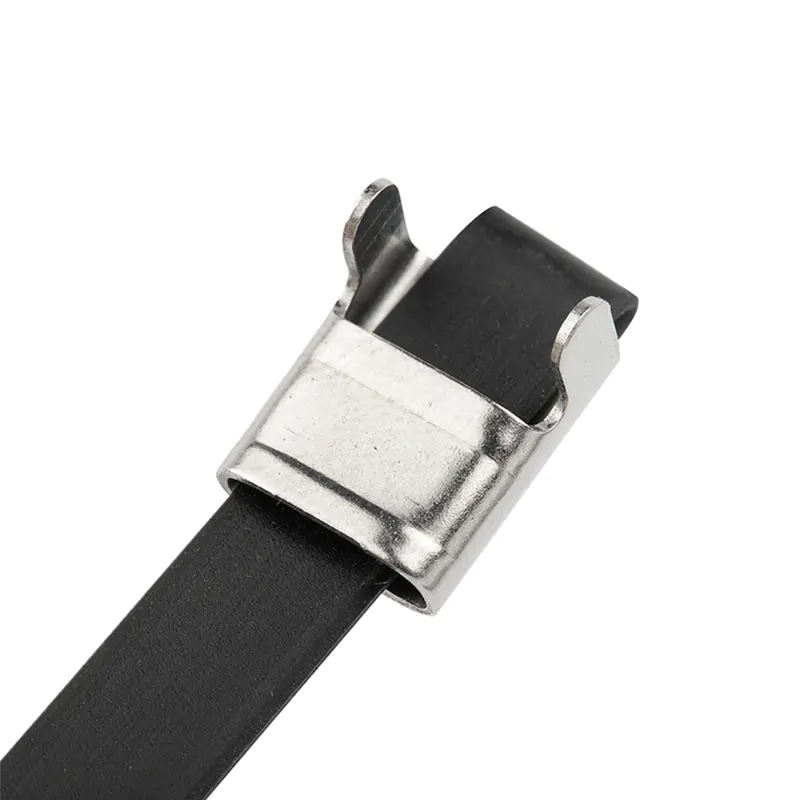
The coating isn’t just for aesthetics; it serves as an ionic barrier that prevents galvanic corrosion and protects delicate cable insulation from being sliced by metal edges. Depending on your business’s specific “threat profile,” you must choose between Polyester, Epoxy, or PVC coatings.
| Coating Type | Primary Benefit | Temperature Tolerance | Recommended Use |
| Polyester | Best UV & Salt Resistance | -60°C to +150°C | Solar farms, offshore wind, marine |
| Epoxy | High Chemical & Abrasion Resistance | -50°C to +150°C | Refineries, mining, heavy machinery |
| PVC (Vinyl) | Softest touch, electrical insulation | -40°C to +105°C | General electrical, hand-installation |
The data in Table 2 highlights why Polyester-coated ties are the gold standard for the renewable energy sector. Because polyester is naturally UV-stable, it will not become brittle under the relentless sun of a desert solar array. Conversely, for businesses in the mining or oil and gas industry, Epoxy-coated ties are often preferred because the coating is incredibly hard and resistant to being “scratched off” during the installation of heavy-duty piping. At Xinxing Cable Tie Supplier, we ensure our coatings are applied with a uniform thickness to prevent any “pinholes” where corrosion could start.
Assessing Tensile Strength and Width
For a business, safety is non-negotiable. You must ensure that the cable ties you purchase can handle the “static load” of the cables plus any “dynamic loads” like wind or vibration. Tensile strength is the measurement of the force required to break the tie or cause the locking mechanism to fail.
| Tie Width (mm) | Standard Tensile Strength | Heavy-Duty Strength | Business Application |
| 4.6 mm | 100 lbs (45 kg) | 150 lbs (68 kg) | Small bundles, sensor lines |
| 7.9 mm | 250 lbs (114 kg) | 350 lbs (159 kg) | Main power cables, cable trays |
| 12.0 mm+ | 500 lbs (227 kg) | 800+ lbs (360 kg+) | Heavy piping, structural support |
When choosing the width for your business application, always aim for a safety factor of at least 2:1. If your cable bundle weighs 50 lbs, do not use a tie rated for 50 lbs; use one rated for at least 100 lbs to account for environmental stress. Larger widths like 7.9mm or 12mm are essential for securing heavy-gauge armored cables in industrial plants. The ball-lock mechanism in our Xinxing coated ties is engineered to “bite” into the metal core, ensuring that once the tie is tensioned, it will never slip, even under extreme physical vibration.
Evaluating Safety and Installation Logistics
A major factor for businesses is the safety of their workers and the integrity of the products they are installing. Bare stainless steel ties have sharp edges that can act like a knife, slicing through the rubber insulation of high-voltage cables during vibration. Coated cable ties eliminate this risk by providing a cushioned, rounded edge.
Beyond cable safety, consider the installer’s safety. Coated ties are significantly easier on the hands than bare metal. However, to achieve the professional tensioning required for business-grade infrastructure, we always recommend using a stainless steel cable tie tensioning tool. These tools allow your team to apply a consistent, pre-set amount of force and provide a “flush cut,” meaning there are no sharp metal tails protruding that could cause injury to maintenance crews later. At Xinxing, we offer both the ties and the specialized tooling to ensure a complete system approach.
ROI: Total Cost of Ownership vs. Unit Price
The final factor for any business decision is the bottom line. While a nylon zip tie might cost $0.05 and a coated stainless steel tie costs $0.50, the “unit price” is a deceptive metric. In an outdoor or corrosive environment, a nylon tie may fail in 2 years, while a coated tie from Xinxing is designed to last 20 to 30 years.
When you factor in the labor cost of sending a technician into the field to replace broken ties—not to mention the potential cost of a fire or short circuit caused by a failed fastener—the ROI of coated cable ties is undeniable. For critical infrastructure, telecommunications, and maritime businesses, using high-quality coated fasteners is a “set it and forget it” solution that protects the company’s reputation and long-term profitability.
Why Choose Xinxing Cable Tie Supplier?
When you source your coated cable ties from Xinxing, you are partnering with an expert manufacturer that prioritizes EEAT (Experience, Expertise, Authoritativeness, and Trust). Our products are:
-
UL & RoHS Certified: Ensuring they meet global safety and environmental standards.
-
Precision Engineered: Our ball-lock mechanism is tested for 100% reliability in high-vibration zones.
-
Sustainably Manufactured: We use high-purity raw materials to ensure maximum corrosion resistance.
-
Customizable: We offer various lengths, widths, and coating materials tailored to your specific industry needs.
FAQs
1. Are coated cable ties worth the extra cost?
Yes, especially for outdoor or industrial use. They prevent “galvanic corrosion” and protect cable insulation from sharp metal edges, extending the life of your entire system by decades and reducing maintenance labor costs.
2. Can I install coated cable ties by hand?
You can pull them hand-tight, but for business-critical infrastructure, a tensioning tool is required. It ensures the locking mechanism is fully engaged and cuts the tail flush to prevent safety hazards.
3. How do I know if I need Grade 316 or 304 stainless steel?
If your business is located near the coast, offshore, or in a facility that uses harsh cleaning chemicals, always choose Grade 316. For standard urban outdoor or indoor industrial use, Grade 304 is usually sufficient.
4. Is the coating on the cable ties flame retardant?
Most high-quality coatings, like the Polyester and Epoxy used by Xinxing, are halogen-free and flame retardant. They do not fuel a fire and do not release toxic gases, making them safe for tunnels and data centers.
5. Can coated cable ties be reused?
No. These are designed for a permanent, one-time installation. Once the ball-bearing locks into the metal core, the tie must be cut to be removed. This ensures maximum security for your electrical bundles.
Conclusion
Choosing coated cable ties for your business is an exercise in risk management. By matching the metal grade (304 vs. 316) to your environment, selecting a coating (Polyester vs. Epoxy) that resists your local stressors, and ensuring adequate tensile strength, you create a fastening system that stands the test of time. Don’t let a small component become a large failure point in your business operations.To choose the best coated cable ties, businesses must evaluate the metal core (Grade 316 for marine, 304 for general), the coating material (Polyester for UV, Epoxy for chemicals), and the required tensile strength. Premium coated ties from Xinxing prevent cable damage and provide a superior long-term ROI compared to standard nylon or bare metal ties.
Ready to secure your business infrastructure with professional-grade fasteners?
Visit Xinxing Cable Tie Supplier today to explore our full inventory of premium coated cable ties. Our team is ready to provide you with the expert advice and high-quality products your business deserves—contact us for a quote today!